Gender & power
5 August 2026
16 min read
Why sameness is not fairness!
Why treating everyone equally can produce unequal outcomes Few ideas sound more fair than the promise to treat everyone the same. Governments promise equal access to public serv…
On this page
Why treating everyone equally can produce unequal outcomes
Few ideas sound more fair than the promise to treat everyone the same.
Governments promise equal access to public services. Institutions commit themselves to equal opportunity. Organisations proudly declare that everyone will be treated without discrimination. Development programmes frequently emphasise that their benefits are available to all.
Equality has become one of the most widely accepted principles of modern public policy.
Yet beneath its moral appeal lies an uncomfortable question.
What if treating everyone the same is precisely what produces unequal outcomes?
That question has shaped much of my thinking over the years — not simply about gender, but about development itself.
It is also one of the questions that artificial intelligence is now forcing us to confront in entirely new ways.
The simplicity of equality
Equality is attractive because it appears objective.
The same school.
The same health facility.
The same employment opportunity.
The same road.
The same financial product.
The same eligibility criteria.
The same rules.
Everyone receives exactly the same intervention.
From an administrative perspective, this seems both efficient and fair.
No one is favoured.
No one is excluded.
Everyone is treated identically.
If fairness means identical treatment, then equality appears to achieve it perfectly.
But this understanding of fairness depends upon one assumption that is rarely examined.
It assumes that people begin from the same position.
It assumes that they encounter institutions in the same way.
It assumes that they experience opportunities similarly.
It assumes that identical interventions produce identical possibilities.
Reality rarely cooperates with those assumptions.
The race that was never equal
Imagine two runners standing at the starting line.
Both are healthy.
Both are equally determined.
Both hear the same starting gun.
But before the race begins, one runner has a heavy stone tied around one leg.
When the race ends, would anyone conclude that the competition was fair simply because both runners started together?
Of course not.
The problem was never the race itself.
The problem was assuming that identical treatment erased structural difference.
The stone mattered.
The intervention — the race — never recognised it.
The same principle appears throughout development, although often in far less obvious ways.
Programmes frequently provide identical opportunities while overlooking the very conditions that determine whether those opportunities can actually be used.
The opportunity exists.
The capacity to benefit from it does not.
Development’s quiet assumption
Much development practice has historically been organised around a remarkably simple idea.
If services are made available, people will use them.
If employment opportunities exist, people will participate.
If schools are built, children will attend.
If health facilities are constructed, communities will benefit.
If roads are provided, people will gain access.
The intervention appears neutral.
Everyone receives the same opportunity.
The programme therefore appears fair.
Yet opportunities never exist independently of the lives people already lead.
People arrive carrying different responsibilities.
Different constraints.
Different histories.
Different risks.
Different resources.
Development often standardises the intervention while reality differentiates the people expected to benefit from it.
That distinction changes everything.
When women were said not to participate
One experience transformed the way I understood this issue.
Throughout much of my work on labour-based road programmes, one concern appeared repeatedly.
Women were underrepresented.
Participation rates were lower than expected.
The diagnosis appeared straightforward.
Women were not participating.
The solution seemed equally straightforward.
Encourage participation.
Introduce targets.
Mobilise communities.
Raise awareness.
Provide training.
Many programmes did exactly that.
Participation increased.
Targets improved.
Reports celebrated success.
Yet something about this explanation never felt complete.
The more time I spent in communities, the more difficult it became to accept the original diagnosis.
Women were not absent because they were unwilling to work.
They were already working.
Before arriving at a road construction site many had already spent hours collecting water, gathering firewood, preparing meals, caring for children, tending gardens, looking after elderly relatives, and completing countless other responsibilities that rarely appeared in labour statistics.
When paid work ended, another shift began.
Household work continued.
Care continued.
Food preparation continued.
The programme assumed women had unused labour waiting to be mobilised.
Reality showed something entirely different.
The issue was never a lack of work.
The issue was how that work was organised.
Seeing time differently
Once women themselves described their daily lives, the problem looked completely different.
The challenge was not participation.
The challenge was time.
Women carried responsibilities that road programmes had never considered.
Paid employment required fitting another activity into days that were already full.
The programme had been designed around an implicit worker who arrived at the workplace free from competing responsibilities.
Many women did not have that freedom.
Their days were structured differently.
Their economic contributions were organised differently.
Their responsibilities extended across productive work, reproductive work and community work simultaneously.
The programme had treated everyone equally.
Reality had not.
The difference mattered.
Not because women were different people.
But because society had organised time differently for women and men.
Once that became visible, the intervention itself began to change.
Changing the programme instead of changing women
Once the reality became visible, something important happened.
The objective of the programme did not change.
It still sought to increase women’s participation in labour-based road construction.
What changed was the intervention.
Instead of asking women to fit the programme, the programme began adapting to the realities women already lived.
Working hours became more flexible so that paid work could be organised around unavoidable household responsibilities rather than assuming they did not exist.
Breastfeeding shelters enabled mothers to care for infants without being excluded from employment.
Where appropriate, family contracts allowed households to organise labour collectively instead of forcing women to choose between paid work and responsibilities at home.
Community liaison officers worked directly with communities to identify practical barriers that standard project procedures had overlooked.
Work organisation itself became more flexible.
None of these measures lowered standards.
None reduced the quality of the roads.
None altered the programme’s objective.
The intervention simply became responsive to reality.
That distinction is fundamental.
Nothing about women changed.
The programme changed.
And participation increased — not because women suddenly became available, but because the intervention finally recognised the conditions under which they already lived.
The lesson has stayed with me ever since.
Fairness is not achieved by asking people to adapt to institutions.
Fairness begins when institutions adapt to people.
Equality and equity ask different questions
This experience revealed something that reaches far beyond transport.
Equality and equity are often treated as interchangeable.
They are not.
Equality asks a straightforward question:
Did everyone receive the same opportunity?
Equity asks a different one:
Could everyone benefit equally from that opportunity?
Those questions may produce very different answers.
An intervention can satisfy equality perfectly while failing completely on equity.
Everyone may receive the same service.
Everyone may face the same procedures.
Everyone may be subject to the same rules.
Yet the outcomes remain profoundly unequal because people’s starting position may not be the same.
Equality focuses on what institutions provide.
Equity focuses on what people are actually able to use.
Development frequently measures the first while assuming the second.
Reality rarely permits that assumption.
Difference is structural, not personal
One of the most persistent misunderstandings surrounding equity is the belief that it is about treating individuals differently because they are different people.
It is not.
Responsive development is not built around personalities.
It is built around structure.
People encounter institutions differently because institutions were rarely designed with everyone in mind.
A pregnant woman does not require exactly the same health services as a man or as a woman who is not pregnant.
Her needs are different because pregnancy creates different health requirements.
Providing antenatal care is not preferential treatment.
It is responsive service delivery.
Similarly, school girls and school boys may attend the same school, study the same curriculum and sit the same examinations.
But if the school provides toilets without private changing facilities or water during menstruation, many girls begin missing classes.
Nothing about their academic ability differs.
The difference lies in whether the institution recognises their reality.
Likewise, a road designed exclusively for motor vehicles serves drivers well.
But if it provides no walkways, cyclists, pedestrians and users of intermediate means of transport remain exposed to unnecessary danger.
The infrastructure exists.
Access does not.
The intervention is equal.
Its usefulness is not.
Persons with disabilities encounter similar barriers every day.
A hospital may proudly provide maternity services for every expectant mother.
Yet if examination tables cannot be reached by women with physical disabilities, or buildings lack ramps and accessible toilets, the service exists only in theory.
Officially, everyone is served.
Practically, some people remain excluded.
The barrier is not the person.
The barrier is the design.
Sometimes exclusion is invisible until you experience it
For many years I understood exclusion largely through research.
Then I experienced it myself.
During a road-sector assignment in Mozambique, I joined a large multidisciplinary team.
Almost everyone spoke Portuguese or Spanish.
I did not.
Most meetings, technical discussions and presentations took place entirely in Portuguese.
No interpretation had been arranged.
For nearly three days I sat through discussions understanding very little.
I could observe.
I could listen.
I could occasionally infer meaning through my knowledge of French, lip reading and context.
But I could not fully participate.
I had been recruited because of my expertise.
Yet language had quietly transformed me from an active contributor into a passive observer.
Physically present.
Intellectually absent.
It is difficult to describe how isolating that felt.
Not because anyone intended to exclude me.
The exclusion resulted from an assumption.
Everyone who mattered was assumed to speak Portuguese.
Eventually, after repeated requests, a translator was found.
The translation was imperfect.
Sometimes discussions had already moved on before interpretation reached me.
But the difference was remarkable.
Nothing about my expertise had changed.
Nothing about my qualifications had changed.
Nothing about my willingness to contribute had changed.
The intervention changed.
A translator cost the project additional resources.
But those additional resources transformed exclusion into participation.
For the first time in my professional life, I understood exclusion not as an abstract concept but as a lived experience.
Accessibility is rarely expensive because people are incapable.
Accessibility becomes necessary because institutions were designed around someone else’s normal.
That insight has shaped how I think about development ever since.
Affirmative action begins with a different understanding of fairness
Few concepts have generated as much misunderstanding in public policy as affirmative action.
Its critics often argue that it gives unfair advantages to particular groups.
Its supporters sometimes describe it simply as correcting historical injustice.
Neither explanation fully captures its purpose.
Affirmative action is fundamentally about responsive institutions.
It recognises that people may satisfy exactly the same qualifications while facing very different structural barriers to reaching the same opportunity.
Its purpose is not to lower standards.
Its purpose is to remove barriers that prevent equally qualified people from benefiting from those standards.
This distinction is essential.
A woman admitted to university through affirmative action is still required to satisfy the minimum academic qualifications for admission.
A candidate contesting an elected office must still satisfy constitutional requirements.
A professional appointment still requires professional competence.
Affirmative action does not replace merit.
It allows merit to become visible by reducing structural obstacles that prevent equally capable people from competing on genuinely equal terms.
The intervention changes.
The standards remain.
Removing barriers is not preferential treatment
Development frequently assumes that removing barriers constitutes giving someone an advantage.
In reality, it often does nothing more than restore fairness.
The Mozambique experience taught me this personally.
When interpretation was eventually provided, nobody suggested that I had received special treatment.
Nobody argued that translation gave me an unfair advantage over my colleagues.
The translator simply removed a barrier that prevented me from contributing the expertise for which I had been recruited.
Without interpretation I was effectively disabled.
With interpretation I was able to do the job everyone already expected me to do.
The translation did not make me more knowledgeable.
It did not make me more qualified.
It merely restored my ability to participate.
That is precisely what responsive institutions seek to achieve.
They remove existing barriers between people and opportunities.
Structural barriers are often invisible to those who do not face them
One reason responsive development remains difficult is that barriers are frequently invisible to those who never encounter them.
Language is one example.
Literacy is another.
Years ago I evaluated an adult literacy programme.
Participants described changes that, to many professionals, appeared almost insignificant.
One woman proudly explained that she no longer got off the bus at the wrong stop because she could finally read road signs.
Another said she could now read medical prescriptions herself instead of guessing the correct dosage for her children.
Others spoke about helping their children with homework, reading market prices, understanding official documents and receiving the correct change after purchases.
The programme had not merely taught reading.
It had transformed access.
Road signs had always existed.
Prescriptions had always been written.
Public information had always been available.
Yet none of these opportunities had truly existed for someone unable to read.
The intervention had not changed the world around them.
It had changed their ability to use it.
The same lesson appears across countless sectors.
Financial services may formally exist for everyone.
But loan applications that require land titles automatically disadvantage people who own no titled property.
Employment opportunities may appear open to all.
Yet advertisements requiring several years of experience automatically exclude recent graduates, regardless of their potential.
Digital government services may improve efficiency.
Yet they exclude citizens without internet access, smartphones or digital literacy.
Each intervention appears neutral.
Each quietly privileges certain realities over others.
The hidden cost of designing for the average
Much public policy is designed around what appears to be an average citizen.
The average patient.
The average commuter.
The average taxpayer.
The average student.
The average worker.
The difficulty is that average people rarely exist.
Societies consist of pregnant women, older persons, children, people living with disabilities, pastoralists, small-scale farmers, urban professionals, informal workers, fishing communities, island districts, mountain communities, migrants, minority-language speakers and countless other realities.
Institutions inevitably simplify this diversity.
The danger arises when simplification becomes standardisation.
The imagined average gradually becomes the implicit prototype around which services are designed.
Everyone else must adapt.
Some adapt easily.
Others struggle.
Still others are excluded altogether.
None of this happens because institutions deliberately seek exclusion.
It happens because responsiveness requires recognising diversity before services are designed.
Standardisation begins by assuming diversity away.
The same intervention rarely produces the same opportunity
This is why development increasingly speaks about differentiated service delivery.
Not because people deserve different standards.
Because they require different pathways to reach the same standard.
A health facility responsive to maternal health does not provide women with privileges unavailable to men.
It recognises that pregnancy creates health needs that require different services.
Accessible public buildings do not privilege persons with disabilities.
They remove barriers that should never have existed.
Separate sanitation facilities for girls do not create inequality.
They enable equal participation in education.
Walkways beside roads do not disadvantage motorists.
They acknowledge that pedestrians also use transport infrastructure.
Each example reflects exactly the same principle.
The objective remains constant.
The pathway changes.
Responsive development does not change fairness.
It changes how fairness is achieved.
That distinction lies at the heart of equity.
Fairness is not the same as uniformity
Perhaps the easiest way to understand the difference between equality and fairness is to leave policy for a moment and think about something much simpler.
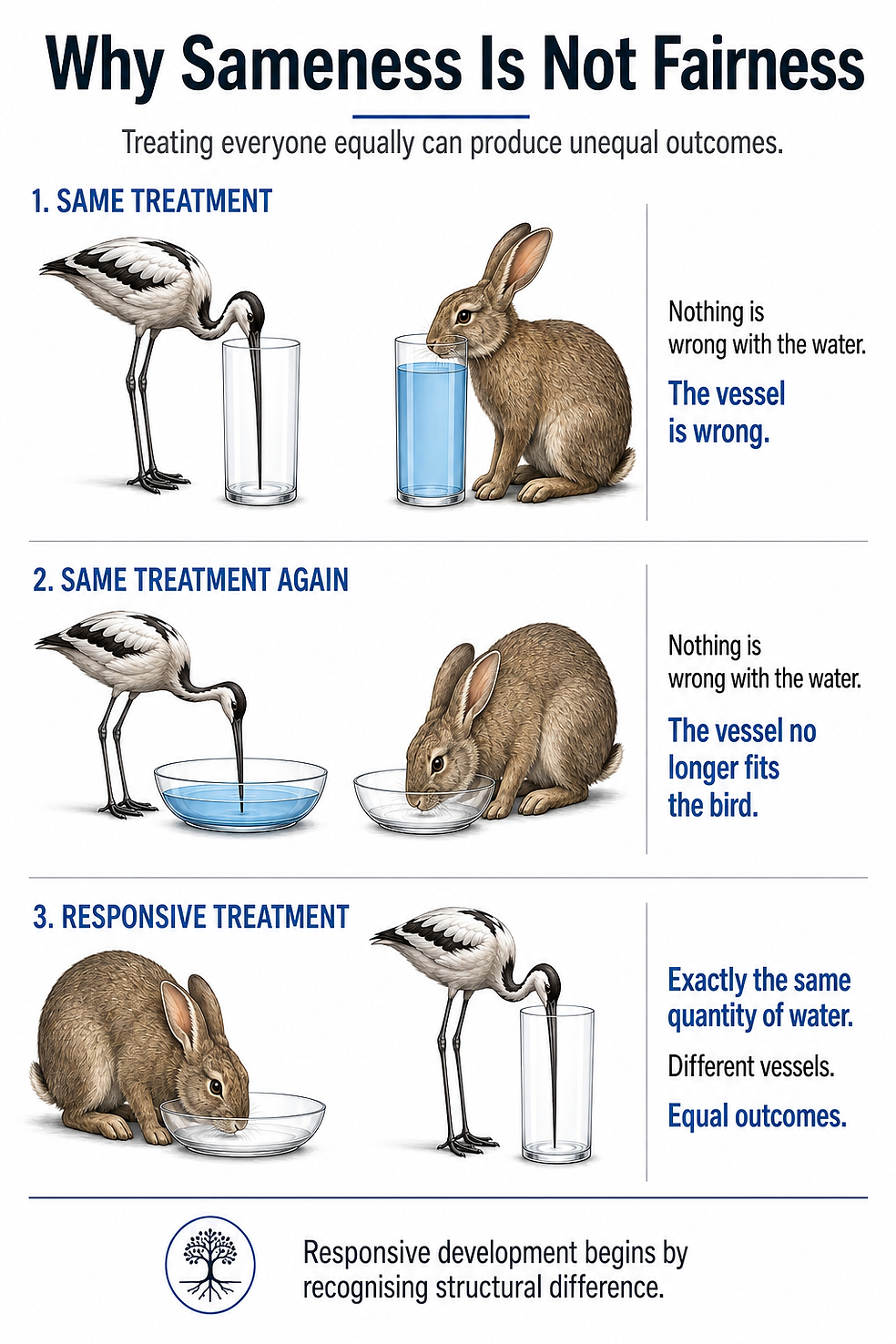
Imagine two animals.
One is a bird with a long, narrow beak.
The other is a rabbit.
Both are thirsty.
Both are given exactly the same quantity of clean water.
The water is identical.
The amount is identical.
Only the vessel changes.
Scenario One
Both receive water in identical shallow bowls.
The rabbit drinks comfortably.
The bird struggles to reach the water.
The opportunity is identical.
The outcome is not.
Scenario Two
Now both receive water in identical tall glasses.
The bird drinks comfortably.
The rabbit cannot reach the water.
Again, the opportunity is identical.
Again, the outcome is unequal.
Scenario Three
Now nothing changes except the vessel.
The bird receives its water in a tall glass.
The rabbit receives exactly the same amount of water in a shallow bowl.
Neither animal receives more.
Neither receives better quality water.
Neither is favoured.
Both drink comfortably.
Both satisfy their thirst.
Nothing changed except the responsiveness of the intervention.
That is equity.
Development often changes the water when it should change the vessel
This simple illustration captures a surprisingly complex principle.
Development often assumes that fairness requires identical interventions.
The same training.
The same infrastructure.
The same services.
The same procedures.
The same opportunities.
Yet people rarely encounter those interventions under identical circumstances.
The intervention may be equal.
Its usefulness is not.
Responsive development therefore asks a different question.
Not:
“Did everyone receive the same intervention?”
But:
“Can everyone benefit equally from this intervention?”
Those questions rarely produce identical answers.
Why responsive institutions matter
This is precisely why modern development increasingly speaks about responsiveness.
Responsive budgeting.
Responsive planning.
Responsive service delivery.
Responsive infrastructure.
Responsive governance.
Responsive development.
These are not fashionable adjectives.
They describe a fundamentally different way of thinking about fairness.
Responsive institutions begin by recognising that populations are not homogeneous.
Communities are not identical.
Districts are not identical.
Households are not identical.
People are not identical.
The objective remains constant.
Access.
Participation.
Health.
Education.
Justice.
Opportunity.
What changes is the pathway through which those objectives are achieved.
That distinction is enormously important.
Responsive development does not abandon universal principles.
It protects universal principles by allowing interventions to vary.
The principle remains universal.
The intervention becomes contextual.
Sameness can actually reproduce inequality
This is why policies that appear neutral sometimes deepen exclusion instead of reducing it.
Suppose every public meeting is conducted only in English.
Everyone is treated identically.
Yet citizens who cannot understand English are effectively excluded.
Suppose every government service becomes digital.
Everyone receives exactly the same online platform.
Citizens without internet access disappear from the service.
Suppose every school provides identical toilet facilities.
Girls continue missing school during menstruation because their needs were never considered.
Suppose every hospital provides identical maternity beds.
Women with physical disabilities remain unable to use them.
Suppose every transport investment prioritises roads.
Island communities continue struggling because their principal transport system is water.
In every case the intervention appears fair.
Everyone receives the same thing.
Yet the same intervention quietly benefits some people more than others because the intervention was designed around one reality while ignoring another.
Sameness therefore becomes an instrument through which inequality is reproduced.
Not intentionally.
Institutionally.
Who decides what ‘normal’ looks like?
At this point another question quietly begins to emerge.
Why do institutions repeatedly design services around one particular way of living?
Why are certain needs recognised automatically while others require special justification?
Why does one design become the default?
The answer is surprisingly simple.
Every institution is designed around an idea of its expected user.
The expected patient.
The expected commuter.
The expected worker.
The expected student.
The expected taxpayer.
The expected citizen.
That person is rarely described explicitly.
Yet they are present in every policy, every guideline, every infrastructure standard and every administrative procedure.
They become the invisible benchmark against which everyone else is measured.
Those who resemble the benchmark rarely notice it.
Those who do not spend much of their lives adapting to it.
That insight leads naturally to an even larger question.
What happens when artificial intelligence begins learning from institutions already designed around an invisible prototype?
That question forms the subject of the next essay.
Because before AI learns who we are, it first learns who our institutions have assumed us to be.
Artificial intelligence inherits our understanding of fairness
Artificial intelligence is often presented as a way of removing human bias.
Algorithms, we are told, treat everyone the same.
They do not discriminate.
They do not become tired.
They do not show favouritism.
They apply the same rules consistently.
At first glance, this appears to be fairness.
But by now we should recognise the question that matters.
Fair according to whose reality?
Artificial intelligence does not invent its own understanding of society.
It learns from ours.
It learns from the data we collect.
It learns from the institutions we have built.
It learns from the services we have designed.
It learns from the policies we have implemented.
Most importantly, it learns from the assumptions already embedded within those systems.
If our institutions have mistaken sameness for fairness, artificial intelligence will not correct that mistake.
It will automate it.
It will reproduce it consistently.
It will scale it.
It will make it more efficient.
The danger is therefore not that AI will suddenly become unfair.
The danger is that it will become exceptionally good at reproducing yesterday’s understanding of fairness.
Responsive development must become responsive intelligence
This is why responsive development matters far beyond development itself.
It offers a different understanding of fairness.
Rather than asking whether everyone received the same intervention, it asks whether everyone has a genuine opportunity to benefit.
Rather than assuming populations are homogeneous, it begins with the recognition that people live different realities.
Rather than forcing people to adapt to institutions, it redesigns institutions so they respond to people.
That shift may appear modest.
It is, in fact, transformational.
It changes how policies are designed.
How services are delivered.
How infrastructure is planned.
How budgets are allocated.
How success is measured.
And increasingly, how artificial intelligence will understand the societies it is asked to serve.
If development fails to recognise structural difference, AI will inherit that failure.
If development learns to design responsive institutions, AI can inherit that lesson instead.
The future of intelligent systems therefore depends, in part, upon whether our institutions first become more intelligent about people.
The deeper lesson
For many years development measured fairness by asking whether everyone received the same intervention.
Experience gradually taught a different lesson.
People do not begin from the same place.
They do not encounter the same barriers.
They do not possess the same resources.
They do not carry the same responsibilities.
They do not experience institutions in the same way.
Treating them identically therefore does not necessarily produce fairness.
Sometimes it produces the opposite.
The challenge is not to abandon equality.
The challenge is to understand what equality requires.
Sometimes equality requires identical treatment.
Sometimes it requires different treatment.
The distinguishing question is always the same.
What prevents this person, this community, or this place from benefiting equally?
Only after answering that question can development decide whether the intervention itself must change.
That is the essence of responsiveness.
Fairness begins with recognition
Development has often been described as the allocation of resources.
Or the delivery of services.
Or the implementation of projects.
This essay suggests something deeper.
Development is also an act of recognition.
It recognises that identical interventions can produce unequal outcomes.
It recognises that structural differences shape people’s ability to benefit from opportunity.
It recognises that justice cannot always be achieved through uniformity.
Only then can interventions become genuinely fit for purpose.
Only then can equality begin to resemble justice.
Only then can development become truly responsive.
Because fairness is not achieved when everyone receives the same intervention.
Fairness is achieved when everyone has a genuine opportunity to benefit.
Sameness is simple.
Responsiveness is harder.
Justice requires the harder path.
If responsive development requires recognising that people experience institutions differently, another question immediately follows.
Why do institutions repeatedly assume that everyone experiences them in the same way?
Put differently:
Who is the “normal” person around whom policies, infrastructure, organisations — and increasingly artificial intelligence — are designed?
That question takes us to the next essay:
The Invisible Prototype
How institutions quietly design the world around an imagined human being — and why AI is about to inherit that design.
Written by Nite Tanzarn.
Published on Nite Tanzarn